My workspace for trading research
SetupLens brings market context, stock research, saved watchlists and a trade journal into one place. It is my private workspace for organizing research and reviewing my process as a momentum trader.
The useful part is the connection between those tasks. A company can look interesting on its own, but I also want to understand the market around it, keep the evidence behind my notes and return to those notes later.
The screens below use selected parts of the existing interface with invented data. Navigation and selected fields are omitted, and the controls are inactive. They show how the workspace is organized, without revealing my trading methods or personal records.
I direct the product: choosing the questions it should help answer, shaping the screens and reviewing changes. AI tools assist with research, implementation and testing.
Start with the wider market
The market and sector views give me a place to examine broad conditions before looking at an individual stock. They show trends and participation across groups, with dates and coverage information alongside the data.
That context helps frame a question: is something happening across a group, or mainly in one company? It does not answer whether I should make a trade.

This panel puts market participation beside its data coverage. All four values are invented for this example; they are not a current market assessment.
Look into a company
The research tools bring together stock charts, news and source-linked filing information. Different views address different questions, and missing inputs remain visible.
I can follow a source and examine what supports a claim instead of relying on a summary alone. Filing research also shows coverage gaps; it cannot establish that every relevant document or event has been found.
Keep the reason, not just the ticker
Saved lists can hold notes and reasons alongside the companies I want to revisit. When an item comes from a supported research view, it can retain a reference to that research session. A manually added item is identified separately.
A saved item can keep a source reference and the date of the observation. That does not always mean the original view can be reopened; SetupLens shows when historical replay is unavailable.
The lists stay in my chosen order. Current prices are separate from the context captured earlier, so a new price does not silently rewrite what I was looking at when I saved something.

The first fictional entry includes a dated research reference and a reason to revisit it. The second is a manual addition. These rows were produced by the application’s existing display code using invented inputs.
Return to the work
The journal brings recorded trading activity, a calendar, review notes and a morning brief into the same workspace. There is room to record what worked, what did not and a specific action to carry into the next session.
This gives me a place to compare what I intended to do with what I recorded doing. The value is having that record available for review; the software does not establish that a decision was good simply because it produced a gain.

These are the existing review fields, filled with fresh example text. They are not excerpts from my journal. The market and journal images show interface layouts, not a demonstration of the calculations or saving process behind them.
One detail worth showing
A research tool should make it clear when it does not know something. SetupLens distinguishes between finding no indexed headline, being unable to check a source and retaining older news.
The demonstration below runs the application’s news display with invented inputs. The three-column layout is an exhibit prepared for this work sample, not a screenshot of the full application. No trades, real watchlists or private research are shown.
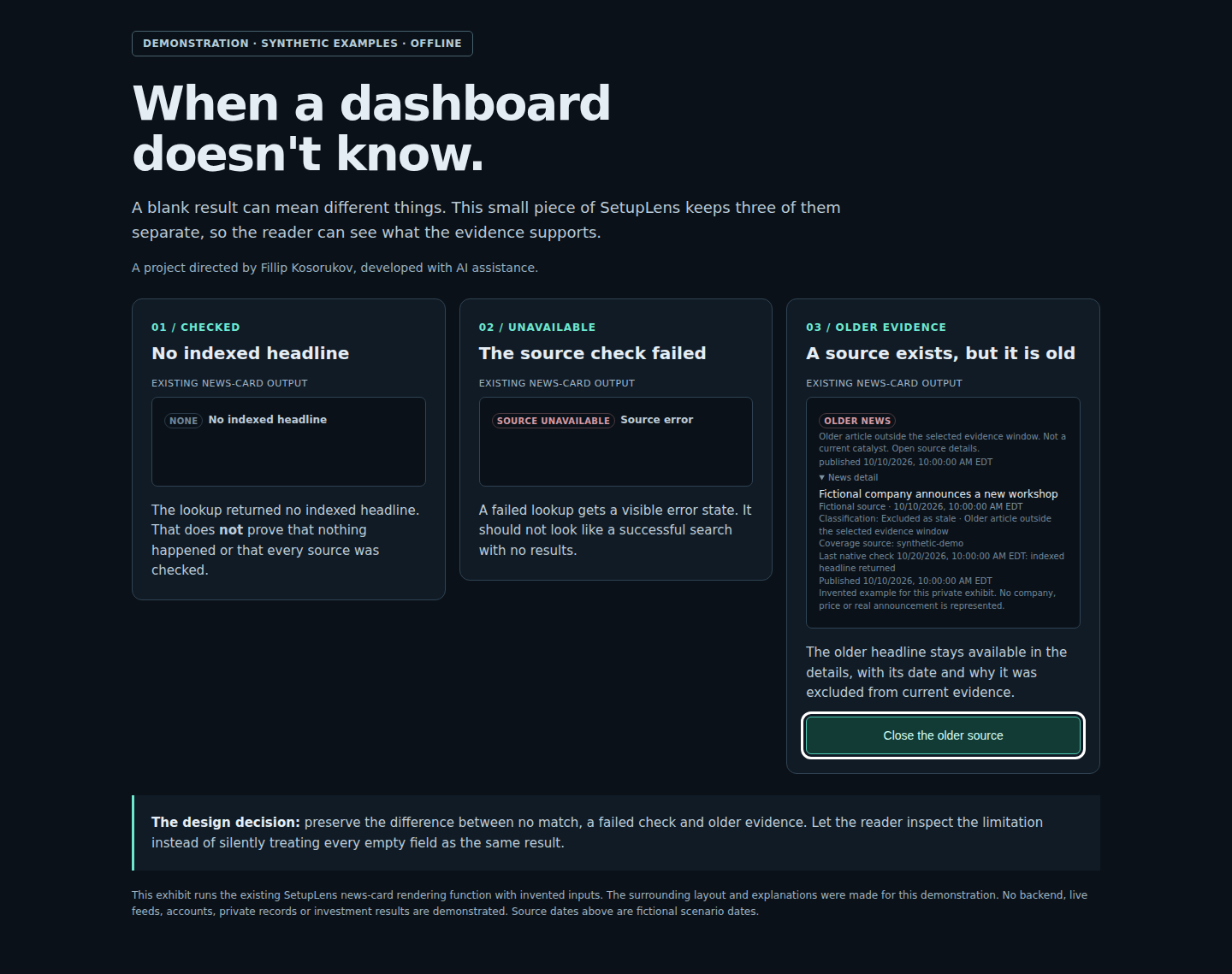
No indexed headline does not prove that nothing happened. A failed check is not an empty result. Older evidence can still be useful when its date and limitations are clear. These are small distinctions, but they affect how I read a dashboard.
My part in it
My work is deciding what belongs in the tool and whether it serves the way I actually work.
SetupLens remains a private research workspace. This sample shows its organization and one display behavior. It does not disclose my trading rules or claim improved returns. Trading decisions stay with me.